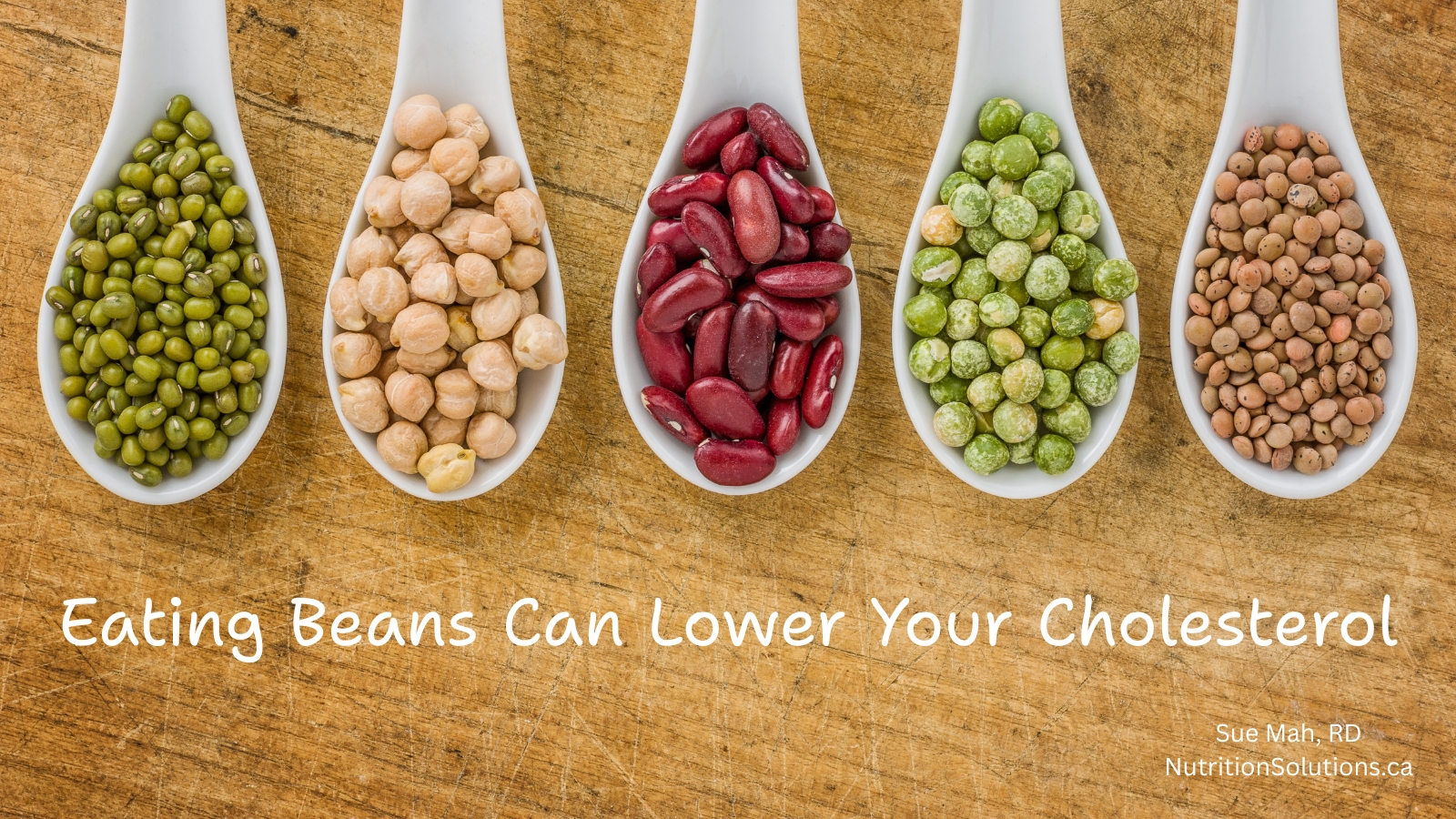
 Interested in lowering your blood cholesterol levels? Research from the University of Toronto found that eating beans can help!
Background
This was a meta-analysis study, meaning that it reviewed the results of many other published studies to come up with one overall conclusion. The meta-analysis looked at 38 studies involving a total of 2,095 adults aged 26 to 64 years who ate pulses. There were about equal numbers of male and female participants. Some of the participants had high blood cholesterol or type 2 diabetes, while others had no health issues at all.
The studies each lasted at least three weeks and up to six weeks. The amount of pulses eaten ranged from 24 to 377 grams per day. The median amount of pulses consumed was 130 grams daily, which is about ½ to ⅔ cup of cooked pulses – either from dried, canned or in products / baked goods made from pulses.
What the meta-analysis found
Eating beans lowered the “bad” low density lipoprotein (LDL) cholesterol by 0.14 mmol/L. Additionally, eating beans lowered the non-high density lipoprotein (non-HDL) cholesterol by 0.22 mmol/L.
What’s non-HDL cholesterol, you ask? Non-HDL cholesterol is the total of all the types of artery-clogging particles which includes low density lipoprotein (LDL), very-low-density-lipoprotein (VLDL), intermediate-density lipoproteins (IDL) and lipoprotein-a. Basically, non-HDL cholesterol is your total cholesterol minus your “good” HDL cholesterol.
These small reductions are still beneficial because high LDL cholesterol levels are a risk factor for cardiovascular disease.
How you can use this info
In Canada, there are specific regulated health claims for foods that have been shown to reduce blood cholesterol levels, including:
- soy protein 25 grams/day
- nuts 45 grams/day
- beta-glucan fibre (e.g. from barley or oats) 3 grams/day
- psyllium fibre 7 grams/day
However, there is no official recommendation for the amount of pulses or beans to consume for heart health.
This meta-analysis shows that eating an average of 130 grams/day of beans (about ½ to ⅔ cup) can lower LDL and non-HDL cholesterol in adults whether or not they have high blood cholesterol or type 2 diabetes. Both the plant-based protein and dietary fibre found in beans likely play a role in lowering blood cholesterol.
So what can you do? Try to include more bean-based meals. Start with at least once a week and work your way up to enjoying beans regularly. Check out these recipes for ideas:
Black Bean, Corn and Avocado Salad
Related blogs: I’m a dietitian and found out I have high blood cholesterol…so here’s what I did to lower it.
Reference: Back S, Yang S, Rossi A, Ayoub-Charette S, Grant SM, Chen V, Lin EJ, Haintz L, Chen YT, Ahmad E, Gahagan J, Marinangeli CPF, Ha V, Khan TA, Blanco Meji S, Zurbau A, de Souza RJ, Beyene J, English MM, Vuksan V, Josse RG, Leiter LA, Kendall CWC, Jenkins DJA, Sievenpiper JL, Chiavaroli L. Effect of Different Types of Whole Dietary Pulses on Established Therapeutic Lipid Targets for Cardiovascular Risk Reduction: An Updated Systematic Review and Dose-Response Meta-Analysis of Randomized Controlled Trials. Journal of the American Heart Association (2026 May 19: 15(10):e046659).