Blog / Recipes

This Could Be a Surprising Health Benefit of Cooking at Home

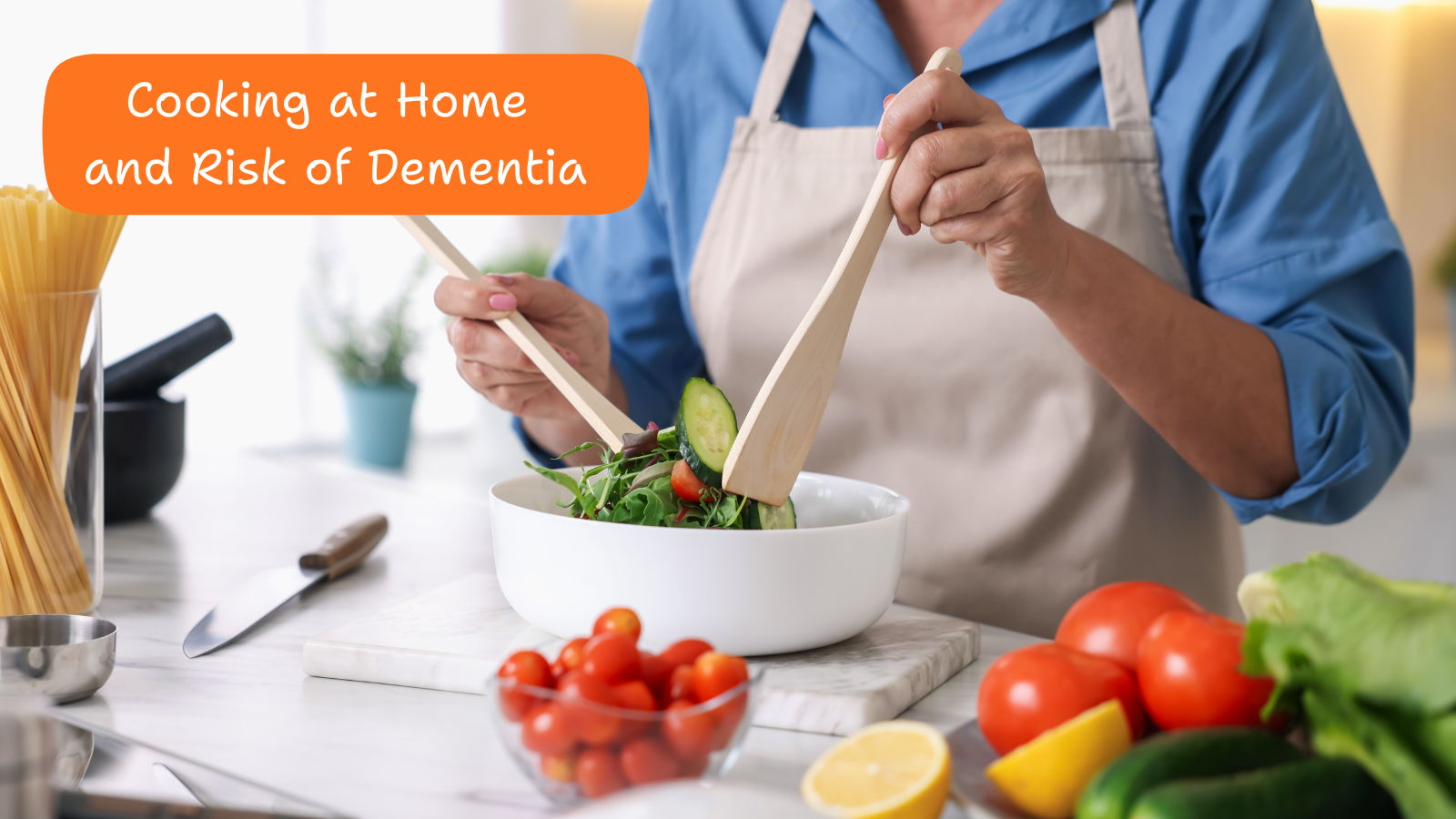
A person wearing an apron and tossing a salad in the kitchenCooking at home has many benefits, such as a lower risk of developing diabetes, eating fewer calories and eating more nutritious foods. But could cooking at home decrease your chances of developing dementia?

Background

Researchers in Japan looked at whether cooking at home affects a person’s chances of developing dementia. The study spanned 6 years from 2016 to 2012, and reviewed almost 11,000 older adults over the age of 65 years who were originally part of a study called the Japan Gerontological Evaluation Study (JAGES). More than half of the participants were retired, half were female, and 20% of the adults were over 80 years or age.

The participants received a questionnaire and were asked to rate their own cooking skills (from unable to very well), and were also asked how often they cooked from scratch every week (from never up to 5x per week.) Long term care health data from home assessments and medical exams were used to assess participants’ cognitive impairment status.

What the study found

About 50% of the participants cooked at least 5 times a week while over 25% did not. Women tended to cook more often than men. Those with higher cooking skills cooked more often than people with low cooking skills.

Overall, cooking at least once a week was associated with a 23% lower risk of dementia in older men and 27% lower risk in older women. The benefit was even higher for people who were novice cooks with lower cooking skills.

Limitations of the study

This study is not direct proof that home cooking prevents dementia. Instead, the research only shows that there could be a link or association between home cooking and a person’s risk of developing dementia.

The study involved older adults who live in Japan and so the results may not apply to other communities. The lifestyle, social and cultural habits of Japanese seniors may be different from your’s. For example, the types of food and how it is cooked varies from culture to culture.

How you can use this information

According to the Alzheimer Society of Canada, there are many risk factors for dementia such as: age, gender, genetics, depression, traumatic brain injury, hearing loss, social isolation, lack of physical activity and poor diet.

While this study doesn’t directly prove that cooking reduces the risk of dementia, there are still many benefits to cooking at home. It’s a task that provides opportunities for cognitive stimulation and physical activity. For example, meal planning consists of thinking about menus, required ingredients, budget, best-before dates and cooking methods. Trying new recipes can also challenge the brain. Shopping for ingredients as well as chopping ingredients and cleaning are active physical tasks for older adults.

If you can, try to cook meals at least once a week. Look for new recipes and experiment with new ingredients. Invite a few friends over to cook and eat with you. Have fun!


References:

– Klein L, Parks K. Home meal preparation: A powerful medical intervention. American Journal of Lifestyle Medicine, 2020 Mar 1;14(3):282-285. 
– Tani YFujiwara TKondo K. Home cooking, cooking skills and dementia requiring long-term care: a population-based cohort study in Japan


Research Recap: Dietary Protein Amounts and the Risk of Type 2 Diabetes

various protein foods such as fish, meat, eggs and milkGetting enough protein is important for good health. But can too little or too much affect your risk for Type 2 Diabetes?

Background

According to the International Diabetes Federation, China has the largest population with diabetes in the world, and almost half of them are undiagnosed. Researchers from the School of Public Health and Fudan University in Shanghai China were interested in exploring the link between protein intake and the risk of Type 2 Diabetes.

The researchers studied 29,517 adults who did not have diabetes. The average age of the participant was 55 years. The study lasted 5½  years from 2017 to 2022. Each of the participants recorded their usual food intake using a validated food frequency questionnaire.

What the study found

After the 5½ years, 5.1% of the study participants (1511 participants) developed Type 2 Diabetes. Those who developed Type 2 Diabetes tended to be older, had high blood pressure, carried excess weight and / or had a family history of diabetes.

Interestingly, the researchers found a U-shaped association between the risk of developing Type 2 Diabetes and the percent of energy (total daily calories) consumed from protein. In other words, people who ate either too little or too much protein had higher chances of developing Type 2 Diabetes.

Let’s look at this scientific graph, taken from the research paper.

A graph showing a flat U shaped curve relationship between risk of developing Type 2 diabetes (Hazard ratio) versus percent of calories consumed as protein (% energy from protein)


Along the vertical axis is the “Hazard ratio” with a 95% Confidence Interval. The hazard ratio measures the relative risk of something happening, in this case, the risk of developing Type 2 Diabetes. A hazard ratio of 1 (shown as the dotted black line in the graph) means that there is no difference in risk. A hazard ratio higher than 1 means increased risk, and lower than 1 means a decreased risk.

The horizontal axis of the graph is the “Energy from protein” – this is the percent of energy (total daily calories) from protein that a person eats. When protein made up between 12.20% to 16.85% of a person’s total daily calories, the risk of developing Type 2 Diabetes has a hazard ratio of less than 1. This is shown as the bottom part of the letter “U” under the dotted black line in the curve. The risk for developing Type 2 Diabetes increased by up to 1½ times when people ate less than 12.20% or more than 16.85% of their daily total calories from protein. The lowest risk of developing Type 2 Diabetes was observed when protein intake was 14.53% of the daily total calories.

How you can use this info

Protein is an important nutrient for many reasons, including bone health, muscle health and immunity. This research, published in Nutrition Diabetes (June 2025) suggests that eating a certain amount of protein may also lower your chances of developing Type 2 Diabetes.

The study found that eating 12.20% to 16.85% of your total daily calories from protein can be protective against developing Type 2 diabetes. Use this range as a guide.

Here’s a sample calculation showing how you would convert these percentages to grams of protein. The average adult eats about 2000 calories a day. So let’s use that number for this sample calculation.

  • For 12.20% of 2000 calories, multiply 0.1220 x 2000 to get 244 calories. One gram of protein contains 4 calories. So divide 244 by 4 to get 61 grams of protein per day.
  • For 16.85% of 2000 calories, multiply 0.1685 x 2000 to get 337 calories. One gram of protein contains 4 calories. So divide 337 by 4 to get 84.25 grams of protein per day.
  • Among the study participants, the lowest risk for developing Type 2 Diabetes occurred when protein comprised 14.53% of the total daily calories. Let’s do the math again. Multiply 0.1453 x 2000 to get 290.6 calories. One gram of protein contains 4 calories. So divide 290.6 by 4 to get 72.65 grams of protein per day.

In general, if you’re eating about 2000 calories a day, you can aim to eat between 61-84 grams of protein. And the lowest risk for developing Type 2 Diabetes in this study group was found among those who ate 72.65 grams of protein per day. Overall, this translates to eating about 20-25 grams of protein at each meal, which is what I generally recommend for muscle health.

Limitations of this study

  • Keep in mind that this study was done on a select group of adults in one specific country. The types of foods consumed by the participants may differ from the foods you typically consume. For example, more than half of the protein eaten by the study participants was plant protein such as soybeans, tofu and nuts.
  • Your protein needs may vary depending on other factors such as your health conditions, bone health, physical activity and strength training.
  • Diet is just one risk factor for Type 2 Diabetes. Your risk of developing diabetes varies with various factors including family history, diet, physical inactivity, high blood pressure, medications and ethnicity.
  • Always check in with your health care provider or a dietitian for personalized advice. Remember, this information is for educational purposes only and is not intended to replace the advice of your health care provider.


Research cited: Xu M, Zheng J, Ying T, Zhu Y, Du J, Li F, Chen B, Liu Y, He G. Dietary protein and risk of type 2 diabetes: findings from a registry-based cohort study and a meta-analysis of prospective cohort studies. Nutr Diabetes. 2025 Jun 3;15(1):25. doi: 10.1038/s41387-025-00380-z. PMID: 40461516; PMCID: PMC12134278.  https://pubmed.ncbi.nlm.nih.gov/40461516/

Research Recap: Surprising Findings about Grocery Flyers in Canada

A red grocery basket filled with foods in a grocery store aisleDo you look at grocery flyers? If yes, the findings of a recent Canadian study may surprise you!
Background

A group of researchers from Saint Mary’s University, Dalhousie University and the University of Waterloo looked at 53 grocery flyers from both discount and regular banner stores across Canada in 2014, 2017 and 2021.

The flyers were collected at least twice each year and not during calendar holidays such as Halloween, Christmas, Valentine’s Day or Easter since theme-related foods tend to be advertised at these times.

In total, 8790 foods and beverages were reviewed for their nutritional quality.

What the study found

Baked products were the largest category of foods advertised in food flyers, making up on average 11% of the entire flyer. Next were non-alcoholic beverages (excluding milk) at 10.7% and then milk / dairy products at 10.2% of the total items found in the flyers.

Vegetables and fruits only comprised 8.3% and 6.5% respectively of the foods advertised in the flyers. Meat products came in at 7.2% and snacks at 5.1%.

When reviewing the nutritional value of the foods / beverages in the flyer, more than half of the items advertised were considered ultra-processed and did not align with Canada’s Food Guide. About one-third of the items in the flyer were unprocessed or minimally processed.

Interestingly, the foods items shown on the flyer cover page were consistently more likely to follow the advice of Canada’s Food Guide. This observation was noticed in both discount and regular banner store flyers located in Ontario, Quebec and Atlantic Canada, but not for Western Canada. (The research authors didn’t explain why this wasn’t noted in Western Canada.)

The bottom line

This was the first nationwide observational study of grocery flyers in Canada and the first to analyze multiple years of flyer data.

As a dietitian, I often suggest planning your weekly meals based on the foods that are on sale. Since the healthier foods are typically found on the first page of the flyer, spend more time looking there and then scan the rest of the flyer for additional items to round out your grocery list.


Research cited: Alisson Dykeman MAHSR, Gabriella Luongo PhD, Leia Minaker PhD, Emily Jago MHK, and Catherine L. Mah MD, PhD . Ultra-processed Foods Frequently Promoted in Canada’s Grocery Flyers from 2014, 2017, and 2021, with Healthier Cover Pages. Canadian Journal of Dietetic Practice and Research (2025, July 14). https://doi.org/10.3148/cjdpr-2025-017