Blog / Recipes

Research Recap: Could 5 extra minutes of sleep help you live longer?

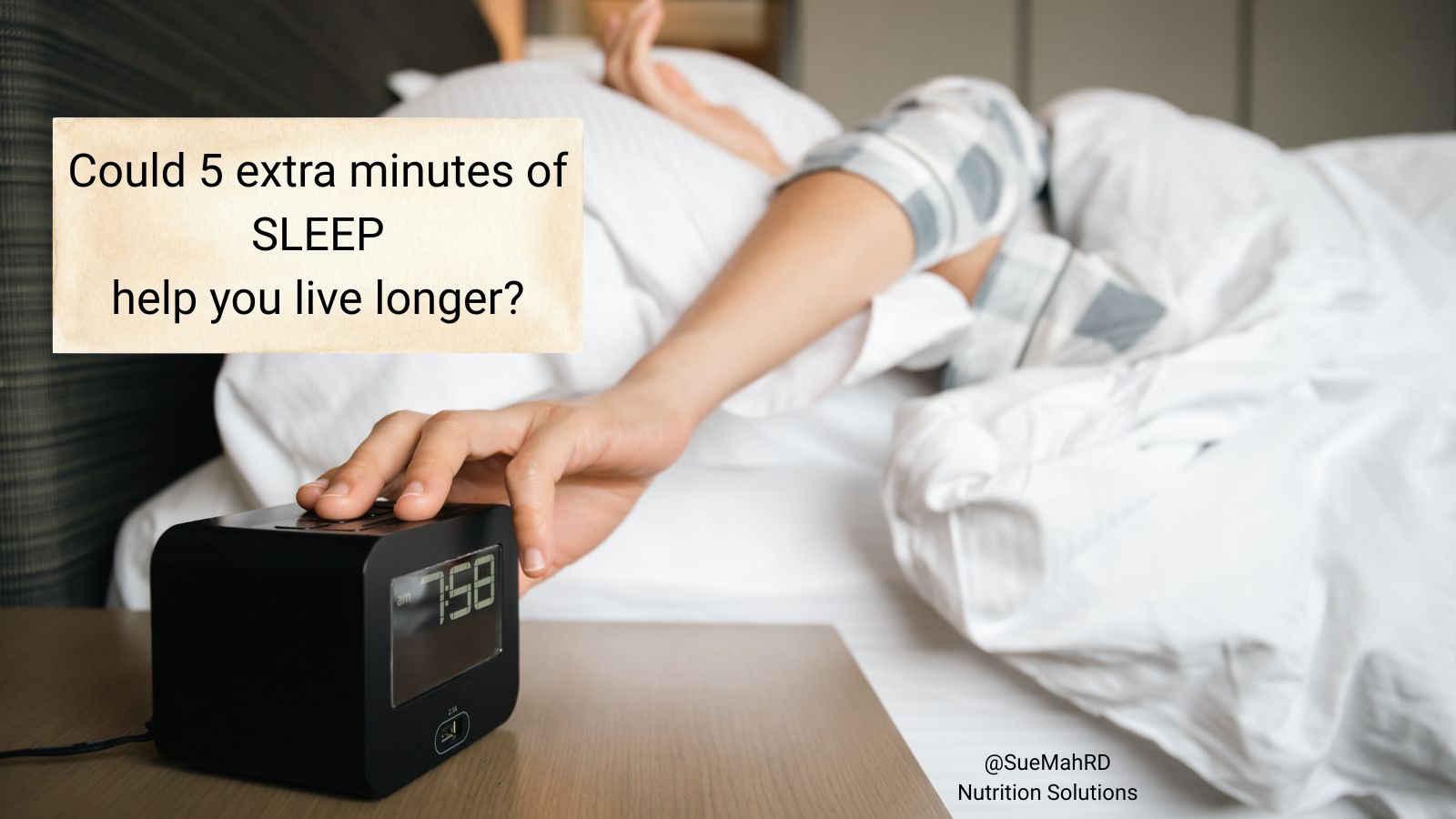
A person sleeping and reaching for alarm clockWant to live longer? Research from the University of Sydney in Australia suggest that small changes to your sleep, physical activity and nutrition can have an impact on both your lifespan and healthspan.

Background

In this study, over 59,000 male and female adults living in the UK wore a wrist accelerometer which tracked their sleep and moderate to vigorous physical activity for 7 days.

Studies typically collect self-reported information about sleep and physical activity. This was the first study to measure these factors using an external device which may be more accurate. Nutrition was still measured with a questionnaire about the participants’ self-reported intake of vegetables, fruits, grains, meats, fish, dairy, oils and sugar-sweetened beverages.

Researchers measured the participants’ health for 8 years and wanted to find the minimum amount of sleep, physical activity and nutrition needed to have a benefit on lifespan and healthspan.

Lifespan is defined as the total number of years a person lives whereas healthspan is the number of years that a person lives in good health, free from chronic illnesses such as cardiovascular disease, cancer and dementia. 

What the study found

The researchers used a baseline of 5.5 hours of sleep a day, 7.3 minutes of physical activity a day, and below average eating habits. From this baseline, getting 5 extra minutes of sleep per day AND an extra 2 minutes of moderate-vigorous physical activity per day AND eating just an extra ½ serving of veggies a day (or an extra 1½ servings of whole grains a day) was associated with 1 extra year of lifespan. All of these extra behaviours needed to be done every day.

Compared to the baseline, healthspan appeared to increase by 4 years when participants did all of the following: slept 24 extra minutes a day, was physically active for 4 extra minutes a day, ate 1 extra cup of veggies, ate 1 extra serving of whole grains, and ate 2 servings of fish per week.

The most optimal combination was getting 7.2-8 hours of sleep per day, more than 42 minutes of daily moderate-vigorous physical activity along with eating a high quality diet. This lifestyle pattern was associated with an extra 9 years of lifespan and another 9.5 years of healthspan.

Limitation of this study

 While this study is interesting, there are a few things to question.

  • The wrist device was only worn for 7 days. Is that long enough to get an accurate reflection of sleep and physical activity habits?
  • The nutrition data was collected 3-9 years before the sleep and physical activity data. Could the participant’s nutrition intake have changed over the 5 years (I would guess yes!) and if so, how would this have changed the results?
  • The researchers followed the participants’ lifespan and health status for 8 years. Is that long enough for a chronic condition to develop?

The researchers also acknowledge that these results are estimated theoretical extrapolations from the data and are not direct observations or direct causes.

How you can use this info

There’s no doubt that sleep, physical activity and good nutrition are important pillars to a healthy lifestyle. Many studies typically look at each of these pillars separately. This study was different in that it looked at how changes to sleep, physical activity and nutrition may work together to potentially delay the onset of chronic disease and increase lifespan. The study tried to find a minimum amount of these healthy behaviours that could have a benefit.

Here’s my advice. Go ahead and hit the snooze button, but don’t use this data as an exact mathematical formula for longevity and health. Instead, it’s your overall lifestyle habits that matter. Aim to get more regular and restorative sleep. Find enjoyable ways to be active every day. Manage stress. Don’t smoke. Go easy on alcohol. And nourish your body by eating nutritious, delicious, wholesome foods.

Reference

Koemel NA, Biswas RK, Ahmadi MN et al. Minimum combined sleep, physical activity and nutrition variations associated with lifespan and healthspan improvements: a population cohort study. eClinicalMedicine, 103741 doi: 10.1016/j.eclinm.2025.103741

Back to School Routine…with a Teen!

Well, we’re finally settled into a new schedule that’s packed with school team practices, extra curricular lessons, and after school clubs. Now that my kids are teens, I’ve learned a few things and have had to adjust my eating plan for them.

1. My teens go to sleep late. What’s happening is a change in their melatonin which is a hormone that regulates the wake-sleep cycle. In young kids, melatonin is released early in the evening, triggering an early bedtime. In adolescents however, the melatonin isn’t released until 9 pm or even 10 pm, meaning that my teens aren’t feeling sleepy until at least 11 pm.
The food fix: Keep plenty of grab-‘n-go foods in the kitchen. With dinner typically at 6 pm, my teens are often hungry for a snack around 9:30 or 10 pm. By creating an environment of healthy food choices such as bagels, tortilla chips, grated cheese, yogurt, fresh cooked meat, fresh fruit and fresh veggies, they can make their own smart snacks while I’m catching my ZZZs.

2. Teens like to sleep in. This is a corollary to lesson #1 above! My teens might have only have 15-20 minutes on a weekday to get up, eat breakfast, change, groom themselves, print out their homework assignment, pack their bags, text their friends, slap on some sunscreen, and then finally jump out the door.
The food fix: Keep it simple in the morning. 20 minutes is definitely doable in the mornings, but to keep things moving along, we focus on easy to eat, protein-filled breakfast options. Some of their favourites are Greek yogurt smoothies, fresh fruit, grilled cheese sandwiches and eggs.

3. Teens can have changing lunch times. Last year,my daughter’s lunch period was at 12:45 pm. This term, it’s at 11:15 am. Next term, her lunch period switches to 12:15 pm.
The food fix: Pack a snack.To ensure that she’s hungry for her early lunch, we try not to have an overly big breakfast. By the time 3:30 rolls around though, she’s absolutely starving, so we pack a little something extra in her lunch bag for those after school munchies.

4. Teens like to buy their lunch. Like all teens, my crew is becoming quite independent and enjoys the freedom to buy their lunch from the school cafeteria or nearby quick service restaurant.
The food fix: We follow the 80-20 rule. On most days of the week, my teens will bring a packed lunch to school. Once a week, they buy their lunch. We talk about healthy choices and money sense. But I never judge them on their choices. I do however, sneak in an extra fruit or veggie at breakfast and suppertime!

Ontario Healthy Kids Strategy

One of the greatest public health concerns today is undeniably childhood obesity. In 1978, only 15% of children were overweight or obese. Almost 30 years later, in 2007, 29% of adolescents were at unhealthy weights. If current trends continue, by 2040, up to 70% of adults aged 40 and over will be either overweight or obese.

Last January, the Ontario government set an aspirational target to reduce childhood obesity by 20% in five years. Charged with this mandate, the Ontario Healthy Kids Panel outlined a three-part strategy in their recent report No Time to Wait: The Healthy Kids Strategy:

1. Start all kids on the path to health. A woman’s health and weight before she becomes pregnant and during pregnancy have a direct influence on her child’s health and weight. The Report recommends pre-natal and educational programs for all young women about the importance of healthy eating, active living, smoking prevention/cessation, and healthy weights. Support is also recommended to encourage women to breastfeed for at least the first six months.

2. Change the food environment. The healthy choices should be the easiest choice where kids live, learn and play. Some of the many recommendations for this strategy include:
• A ban on the marketing of high calorie, low nutrient foods/beverages/snacks to kids under the age of 12;
• A ban on point-of-sale promotions and displays of high-calorie, low-nutrient foods and beverages in retail settings, beginning with sugar-sweetened beverages;
• Mandatory calorie listing on menus at restaurants, fast food outlets and retail grocery stores;
• Nutrition rating systems for products in-store;
• Incentives for Ontario food growers and producers to support community-based food distribution programs;
• Access to safe, affordable, nutritious and culturally appropriate foods, especially in areas of low income and “food deserts”; and
• A universal school nutrition program for all Ontario publicly funded elementary and secondary schools.

3. Create healthy communities. A comprehensive healthy kids social marketing program is needed to focus on healthy eating, active living and active transportation, mental health and adequate sleep. The Report recommends implementing community based programs based on EPOCE (Ensemble Prévenons l’Obesité des Enfants – Together Let’s Prevent Childhood Obesity) which is used in 15 countries worldwide. The EPODE philosophy involves mobilizing all local stakeholders in an integrated, long-term obesity prevention program. The aim is to change the environment and facilitate the adoption of healthier behaviours and lifestyles into everyday life.

My take on the Report: Having just finished writing a series of key messages on healthy weights for children and teens, I was thrilled to see the Healthy Kids Panel Report acknowledge the key determinants impacting a child’s weight – healthy eating, food and nutrition skills, active living, adequate sleep, mental health, resilience and the influential role of parents, teachers and caregivers.

Given the recent controversy over NYC’s soda ban though, I wonder how a junk food ban would be received. Neither a junk food ban nor an advertising ban helps kids with media literacy or how to discern between truth and advertising. We don’t even have an official definition of “healthy food” in Canada, so where would we start in defining “unhealthy”?

I’d also love to see more dialogue on how to eat, not just what or what not to eat. Research tells us that mindless eating is an unhealthy habit which can have negative consequences on our satiety cues and overall intake.

Finally, let’s be careful not to point blame at anyone or anything. The Report acknowledges that some children are genetically predisposed to be heavier. There are over 50 different genes that contribute to obesity. All efforts in reducing overweight and obesity must be free of any weight stigmatization or bias, and involve all players – individuals, communities, politicians and food industry.

The Healthy Kids Panel has mapped out an incredibly ambitious goal – to reduce childhood obesity by 20% in five years. I’ll be watching, listening, helping and hoping that we’ll get there.

To read the full report, go to http://www.health.gov.on.ca/en/common/ministry/publications/reports/healthy_kids/healthy_kids.pdf