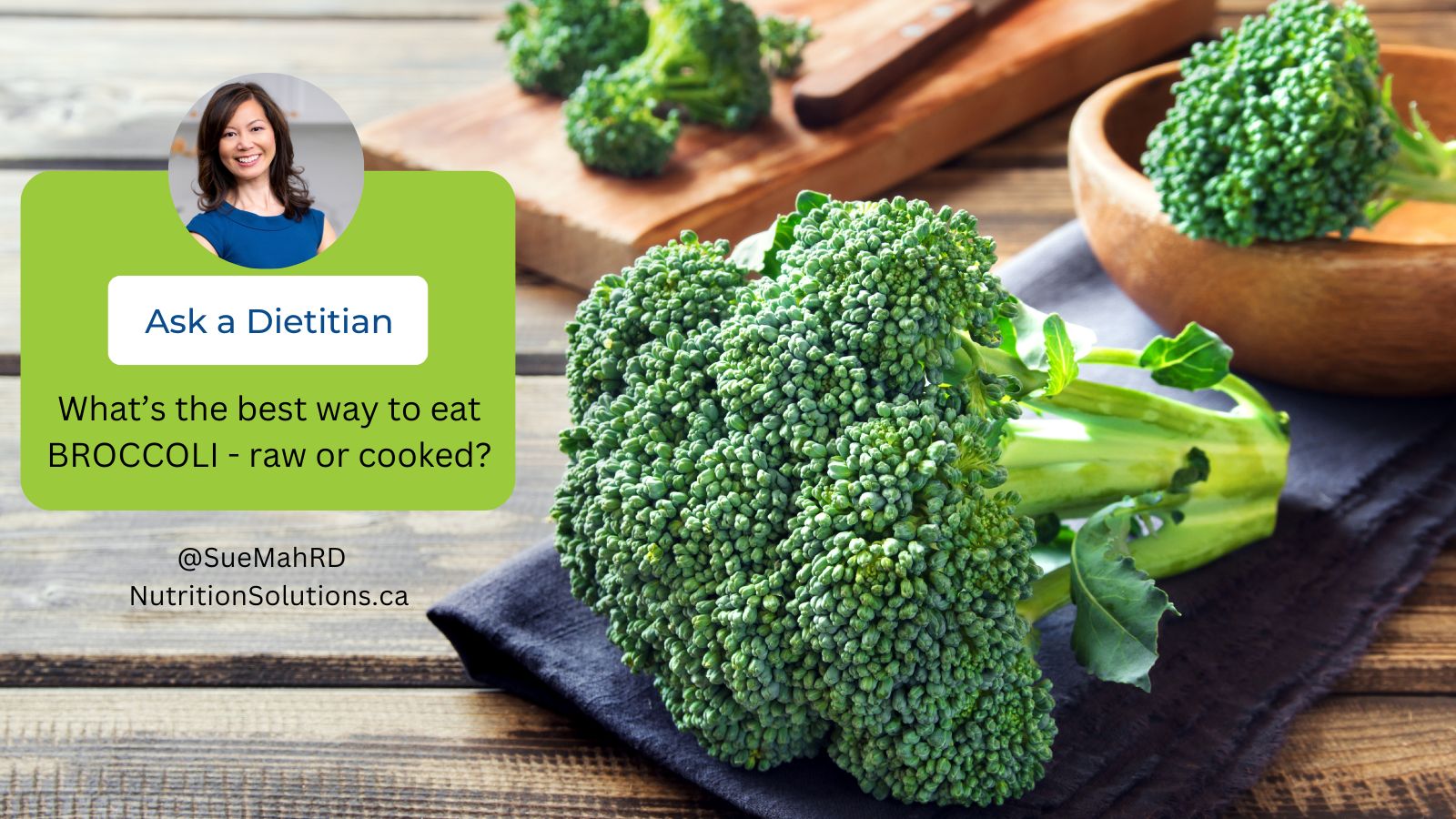
 Broccoli is one of my favourite veggies. And for good reason. It’s packed with nutrients like vitamin C, vitamin K, folate, fibre and beta-carotene. Both raw and cooked broccoli contain a special type of plant chemical called glucosinolates, only found in cruciferous vegetables.
Ok, now we’re getting into some food chemistry, so stay with me. During food preparation and cooking, an enzyme called myrosinase breaks down the glucosinolates into active, cancer-fighting compounds called isothiocyanates. Sulforaphane is one of the most common types of isothiocyanates.
Raw broccoli
When you chew raw broccoli, you’re actually helping to activate the enzyme myrosinase and this means sulforaphanes will be produced. The number of times you need to chew broccoli is unclear (I’ve seen anecdotal reports of chewing broccoli for 30 seconds), so take your time and enjoy. Chopping the broccoli ahead of time could help too (more on this below).
Cooked broccoli
When it comes to cooking broccoli, lightly stir-frying, microwaving for under 5 minutes or steaming for less than 6 minutes seem to be best because these methods help to preserve the cancer-fighting compounds. Cooking for too long and at high temperatures actually destroys the enzyme myrosinase.
If you’re like me and prefer the taste of cooked broccoli over raw, you can add myrosinase containing foods to boost the formation of sulforaphanes. Mustard, mustard powder, radish, arugula, wasabi and other uncooked cruciferous veggies (e.g. cabbage, cauliflower, Brussels sprouts, kale) all contain myrosinase. So try mixing these into your cooked broccoli. One study from the UK found that adding about ½ tsp of mustard powder to 1.5 cups of cooked broccoli increased the sulforphane content by almost 4 times.
Chop it first!
Interestingly, researchers in China found that chopping broccoli 90 minutes before cooking actually increased the amount of cancer-fighting compounds by over 2.5 times! Similar to chewing, the cutting / chopping activates the enzyme myrosinase. If 90 minutes is unrealistic, try chopping broccoli first and allow it to sit before prepping your other ingredients.
The bottom line
Raw broccoli may have an advantage when it comes to sulforaphane content and cancer protection. Honestly though, just eat broccoli in a way that tastes good to you. Simply eating broccoli 1-2 times a week – raw or cooked – can have big health benefits on cancer prevention and your lifespan!
(Thanks to reader GM for asking this question!)
References:
Barba FJ et al. Frontiers in Nutrition 2016 August 15: 3(24). Bioavailability of glucosinolates and their breakdown products: Impact of processing. https://pmc.ncbi.nlm.nih.gov/articles/PMC4985713/ doi: 10.3389/fnut.2016.00024 Accessed March 6, 2026.
Liu X et al. Frontiers in Nutrition 2024 Jan 8:10:1286658. Prospective cohort study of broccoli consumption frequency and all-cause and cause-specific mortality risks. https://www.frontiersin.org/journals/nutrition/articles/10.3389/fnut.2023.1286658/full doi: 10.3389/fnut.2023.1286658. Accessed March 6, 2026.
Lu Y et al. Food Sci Nutr 2020 Mar 5;8(4):2052–2058. Microwave cooking increases sulforphane level in broccoli. https://pmc.ncbi.nlm.nih.gov/articles/PMC7174218/ doi: 10.1002/fsn3.1493 Accessed March 6, 2026.
Okunade O et al. Molecular Nutrition and Food Research 2018 Sep;62(18):e1700980. Supplementation of the diet by exogenous myrosinase via mustard seeds to increase the bioavailability of sulforaphane in healthy human subjects after the consumption of cooked broccoli. doi: 10.1002/mnfr.201700980. Accessed March 6, 2026.
Wu, Y et al. Journal of Agriculture and Food Chemistry 2018 Jan 22; 66(6). Hydrolysis before stir-frying increases the isothiocyanate content of broccoli. https://pubs.acs.org/doi/10.1021/acs.jafc.7b05913 Accessed March 6, 2026.