Blog / Recipes

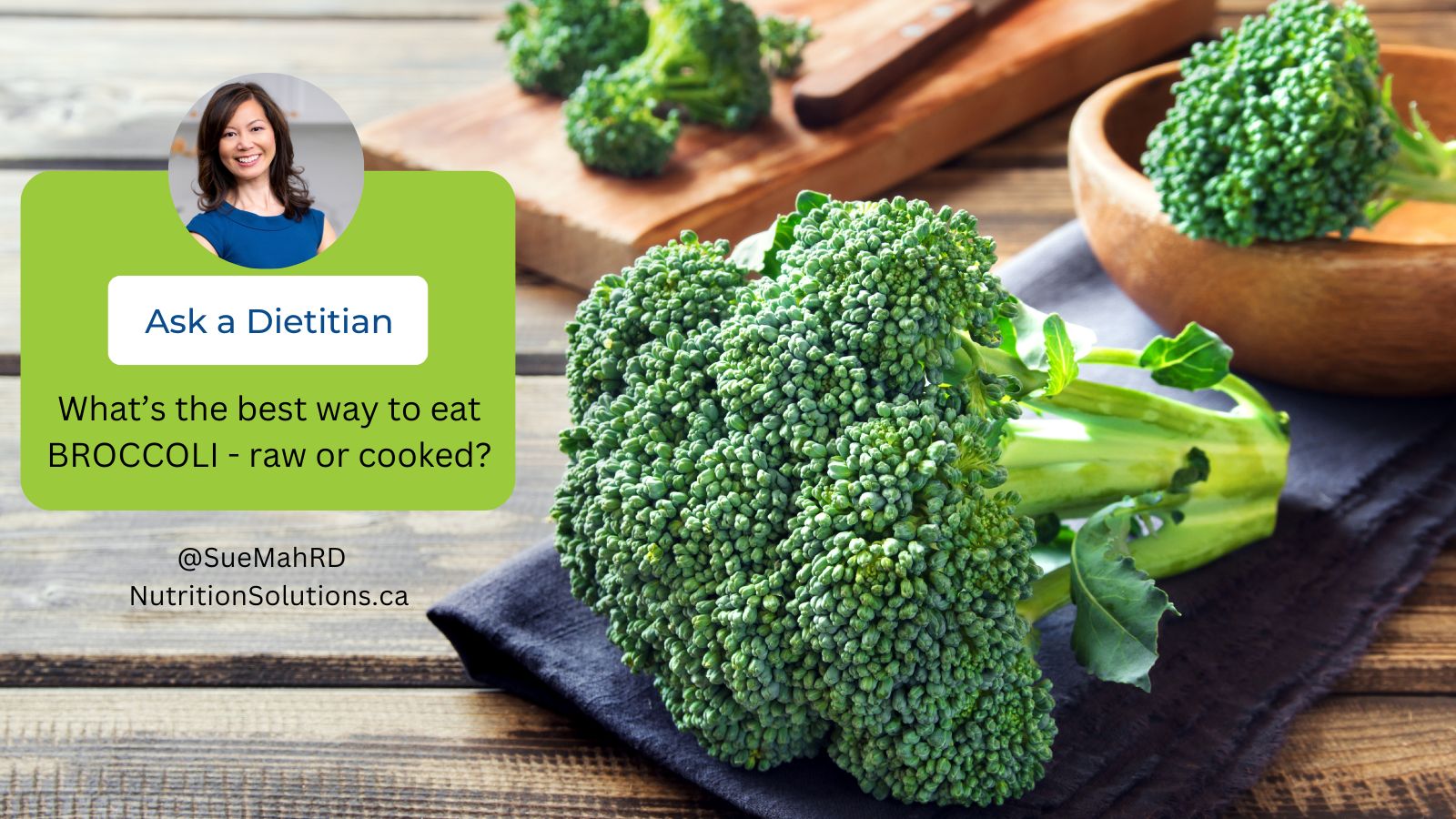
What’s the best way to eat broccoli?

Broccoli is one of my favourite veggies. And for good reason. It’s packed with nutrients like vitamin C, vitamin K, folate, fibre and beta-carotene. Both raw and cooked broccoli contain a special type of plant chemical called glucosinolates, only found in cruciferous vegetables.

Ok, now we’re getting into some food chemistry, so stay with me. During food preparation and cooking, an enzyme called myrosinase breaks down the glucosinolates into active, cancer-fighting compounds called isothiocyanates. Sulforaphane is one of the most common types of isothiocyanates.

Raw broccoli

When you chew raw broccoli, you’re actually helping to activate the enzyme myrosinase and this means sulforaphanes will be produced. The number of times you need to chew broccoli is unclear. I’ve seen anecdotal reports of chewing broccoli for 30 seconds, but there’s not any research to confirm this, so take your time and enjoy. Chopping the broccoli ahead of time could help too (more on this below).

Cooked broccoli

When it comes to cooking broccoli, lightly stir-frying, microwaving for under 5 minutes or steaming for less than 6 minutes seem to be best because these methods help to preserve the cancer-fighting compounds. Cooking for too long and at high temperatures actually destroys the enzyme myrosinase.

If you’re like me and prefer the taste of cooked broccoli over raw, you can add myrosinase containing foods to boost the formation of sulforaphanes. Mustard, mustard powder, radish, arugula, wasabi and other uncooked cruciferous veggies (e.g. cabbage, cauliflower, Brussels sprouts, kale) all contain myrosinase. So try mixing these into your cooked broccoli. One study from the UK found that adding about ½ tsp of mustard powder to 1.5 cups of cooked broccoli increased the sulforphane content by almost 4 times.

Chop it first!

Interestingly, researchers in China found that chopping broccoli 90 minutes before cooking actually increased the amount of cancer-fighting compounds by over 2.5 times! Similar to chewing, the cutting / chopping activates the enzyme myrosinase. If 90 minutes is unrealistic, try chopping broccoli first and allow it to sit before prepping your other ingredients.

The bottom line

Raw broccoli may have an advantage when it comes to sulforaphane content and cancer protection. Honestly though, just eat broccoli in a way that tastes good to you. Simply eating broccoli 1-2 times a week – raw or cooked – can have big health benefits on cancer prevention and your lifespan!

(Thanks to reader GM for asking this question!)

References:

Barba FJ et al. Frontiers in Nutrition 2016 August 15: 3(24). Bioavailability of glucosinolates and their breakdown products: Impact of processing. https://pmc.ncbi.nlm.nih.gov/articles/PMC4985713/ doi: 10.3389/fnut.2016.00024 Accessed March 6, 2026.

Liu X et al. Frontiers in Nutrition 2024 Jan 8:10:1286658. Prospective cohort study of broccoli consumption frequency and all-cause and cause-specific mortality risks. https://www.frontiersin.org/journals/nutrition/articles/10.3389/fnut.2023.1286658/full doi: 10.3389/fnut.2023.1286658. Accessed March 6, 2026.

Lu Y et al. Food Sci Nutr 2020 Mar 5;8(4):2052–2058. Microwave cooking increases sulforphane level in broccoli. https://pmc.ncbi.nlm.nih.gov/articles/PMC7174218/ doi: 10.1002/fsn3.1493 Accessed March 6, 2026.

Okunade O et al. Molecular Nutrition and Food Research 2018 Sep;62(18):e1700980. Supplementation of the diet by exogenous myrosinase via mustard seeds to increase the bioavailability of sulforaphane in healthy human subjects after the consumption of cooked broccoli. doi: 10.1002/mnfr.201700980.  Accessed March 6, 2026.

Wu, Y et al. Journal of Agriculture and Food Chemistry 2018 Jan 22; 66(6). Hydrolysis before stir-frying increases the isothiocyanate content of broccoli. https://pubs.acs.org/doi/10.1021/acs.jafc.7b05913 Accessed March 6, 2026.

Research recap: Eating cruciferous veggies lowers blood pressure

A bowl with broccoli and Brussels sprouts

A recent article published in the journal BMC Medicine found that eating cruciferous veggies such as broccoli and cauliflower are better than root veggies when it comes to lowering your blood pressure. Here’s what you need to know about the study.

Background

Scientists from the Nutrition and Health Innovation Research Institute at Edith Cowan University in Australia recruited 18 adults aged 56 to 72 years who had mildly high blood pressure (systolic blood pressure of 120-150 mmHg).

The participants were divided into two groups. Group A received soups for their lunch and dinner meals made with a total of 300 grams (about 4 servings) of cruciferous vegetables such as broccoli, cabbage, cauliflower and kale. Group B also received soups for their lunch and dinner meals, but these were made with 300 grams of root vegetables like carrots, potatoes, sweet potatoes and pumpkin. Both groups ate these soups (without adding any extra salt) for two weeks in addition to their usual breakfast and snacks.

The participants then went back to their usual diets for two weeks and then the researchers switched the soups. So Group A now received the root vegetable soup for two weeks and Group B received the cruciferous vegetable soup for two weeks. The participants’ blood pressure was measured several times every day throughout the study.

What the study found

The study found that eating about four servings of cruciferous veggies every day significantly lowers systolic blood pressure by 2.5 mmHg. While this seems like a small impact, it actually translates to a 5% lower risk of heart disease!

The bottom line

One limitation of the study is that it involved a very small number of participants which were predominantly Caucasian females. However, it was the only study in humans to show improvements in blood pressure after eating cruciferous veggies for just a short period of time. This beneficial effect may be due to special compounds called glucosinolates which are only found in cruciferous vegetables.

Since high blood pressure is a leading risk factor for heart disease, it’s a good idea to include cruciferous veggies regularly in your meals. There are lots to choose from: arugula, bok choy, broccoli, Brussels sprouts, cabbage, cauliflower, collard greens, horseradish, kale, radish, turnips and watercress.

Here are a few recipes you can try:

Beet Salad with Goat Cheese and Arugula

Beef & Bok Choy Stir-fry

Roasted Brussels Sprouts

Quinoa Salad with Beets, Oranges and Arugula


Broccoli Coffee – Do or Ditch?

latte 2

The other day, a colleague of mine asked on Twitter whether I was nay or yay for the latest trend – broccoli coffee!

In an effort to help Australians eat more fruit and veggies, researchers at the Commonwealth Scientific and Industrial Research Organization (CSIRO) created a broccoli powder made from both the florets and stems. Turns out that every two tablespoons of this powder contains about one serving of broccoli. While the broccoli powder could be used in smoothies, soups and baked goods, a café in Melbourne started adding it to coffee. The marketing pitch is that you’d get your first serving of veggies even before breakfast.

My take – I LOVE the idea of using all parts of the plant and reducing food waste, I’m not so sure coffee fans will perk up to the flavour (or smell?) of this new concoction. Personally, I like my coffee double-double (I only drink coffee about once a week) and I love my broccoli lightly steamed.

What do you think? Would you try broccoli coffee?

Veggies are Trending for Culinary Inspirations

“Anyone can cook a hamburger, leave vegetables to the professionals.”

That’s Amanda Cohen’s mantra. The Canadian born chef and owner of Dirt Candy restaurant in NYC is on to something with her vegetable inspired menu.

[Pictured: Cohen’s Broccoli Dogs – grilled and smoked broccoli sautéed in broccoli oil, and served with a side of broccoli kraut and broccoli rabe chips.]

Here are highlights from my amazing interview with Chef Cohen.

Tell me a bit about yourself.

Cohen: I was born in Ottawa but grew up in Toronto. I came to New York to go to NYU and never looked back. I wet to the Natural Gourmet Institute’s Chef’s Training Program and after that I worked in pretty much every single restaurant I could for about 10 years. I realized that no one was going to give me a chance to cook the kind of food I wanted to cook, so I opened the original Dirt Candy in 2008. It’s been going like gangbusters ever since.

What inspired you to focus on vegetables only?
Cohen: There are hundreds of steak houses, thousands of seafood restaurants, millions of hamburger restaurants, but Dirt Candy is the only restaurant that only focuses on vegetables. I’m not making vegetarian food, and I’m not making fish with a lot of vegetable sides. I’m cooking vegetables. I’m sitting here in my kitchen and running it like a lab, seeing how far I can push each vegetable and what kind of flavor I can get out of them. No one else is doing this, so for me, it’s like being in the Wild West. There are no rules, and no one telling me what I should do. I love it!

Why are vegetables so tricky to work with?
Cohen: Vegetables are tricky because they have no fat…fat carries flavor, so you have to add [flavor] yourself. Also, vegetables have a high water content that you have to get rid of somehow when you cook them. And finally, vegetables have a uniform texture throughout and don’t have the different flavours and textures that say a big chunk of steak will have. To make vegetables taste good, you really have to work.

Tell us about your Broccoli Dogs!
Cohen: I spent three months trying to make them work before throwing everything out and starting from scratch, which took another four weeks. I experimented with 38 different doughs before finding the right one I use for the bun.

Any plans to open a Dirt Candy in Canada sometime??
Cohen: I wish!

Book Review – Unmasking Superfoods – by Jennifer Sygo, MSc., RD

It’s not always easy to find a nutrition book that’s easy to read and backed by credible research. But Sygo does just that. In Unmasking Superfoods, Sygo separates the truth from the hype behind some of today’s superfoods such as acai, noni, quinoa and the increasingly popular coconut oil. She also gives a shout out to kiwi, pistachios and mussels, calling them underappreciated superfoods. In another chapter of the book, Sygo offers a sound perspective on beef, eggs, potatoes and other foods which she feels have been given a bad rap.
For each superfood, you’ll learn about the backstory, the nutritional profile, the science-based health impacts, and finally the bottom line. Unmasking Superfoods is literally a mini nutrition encyclopedia for consumers and health professionals alike. It’s a keeper on my bookshelf.