Blog / Recipes

3 Important Nutrients for Vegetarians

Various fruits and vegetables on a cutting board and tableThis article originally appeared on Canadian Food Focus, and I received monetary compensation from them to research and write this information. My articles represent my personal and professional views. I am one of many dietitian writers for Canadian Food Focus, which is a source for Canadian food and farming stories that provide advice to help you make confident food choices.

If you’re a vegetarian, you’re probably eating a variety of plant-based foods such as fruits, vegetables, whole grains, legumes, nuts and seeds. Following a plant-based eating style has many benefits, such as a lower risk for developing heat disease, type 2 diabetes and colon cancer. But did you know that you could be missing out on some important nutrients? Here are 3 key nutrients to think about.

Iron

Iron is a part of hemoglobin that’s in red blood cells and helps carry oxygen throughout our body. There are two different forms of iron:

  • heme iron – found in animal-based foods such as meat, poultry, fish, shellfish and eggs
  • non-heme iron – found in plant-based foods such as vegetables, grains, legumes and tofu.

Heme iron has better bioavailability, in other words, it is more easily absorbed by our body compared to non-heme iron. For this reason, it’s recommended that vegetarians get almost two times more iron as non-vegetarians, especially adults and adolescent females.

To improve the absorption of non-heme iron, try these tips:

  • Enjoy your meal with a food or drink that contains vitamin C (e.g. citrus fruit, citrus fruit juice, kiwis, mangoes, cantaloupe, sweet peppers, bok choy, broccoli, kale, potatoes).
  • Add a food that contains heme iron if you include these foods in your diet (e.g. fish, shellfish, eggs).
  • Cook with cast iron pots.
  • Avoid drinking large amounts of coffee or tea, or having high amounts of calcium at the same time as your vegetarian meal because these block iron absorption. Wait about one to two hours after a meal before enjoying coffee, tea or taking calcium supplements.
  • Try the Lucky Iron Fish, a reusable cooking tool that adds extra iron to your foods and beverages.

Best vegetarian foods for iron:

  • Iron-fortified grain products (e.g. breads, cereals, pasta)
  • Whole grains and whole grain foods
  • Legumes (e.g. split peas, lentils, beans)
  • Soy / soy products (e.g. firm or extra firm tofu, tempeh, soy veggie burger, fortified soy beverage)
  • Nuts / nut butter
  • Seeds / seed butter (e.g. pumpkin seeds, sesame seeds, hemp seeds)
  • Dark green vegetables (e.g. Swiss chard, asparagus, edamame, snow peas, kale)
  • Dried fruit (e.g. raisins, dried apricots)
  • Prune juice
  • Blackstrap molasses

Zinc

Zinc is important for a strong immune system and helps with wound healing. Vegetarians, especially vegans, can be at a higher risk for zinc deficiency because fruits and vegetables contain very little zinc. If you’re a pescatarian, try fish and seafood for zinc. If you’re a lacto-ovo vegetarian, you can get zinc from eggs and dairy products.

Plant-based foods contain phytates (a natural substance found in grains, nuts, seeds and legumes) which actually reduces zinc absorption. To improve the absorption of zinc, try soaking grains, nuts, seeds and legumes before cooking.

Best vegetarian foods for zinc:

  • Legumes (e.g. beans, split peas, lentils)
  • Nuts and nut butters (e.g. almonds, peanuts, cashews, pecan, pine nuts)
  • Seeds (e.g. pumpkin seeds, sunflower seeds, sesame seeds)
  • Whole grains
  • Fortified cereals

Vitamin B12

Vitamin B12 is important for healthy nerve cells and for making red blood cells. Vitamin B12 is found naturally only in animal-based foods. Many plant-based foods are fortified with vitamin B12 such as fortified plant-based beverages and products labelled as “simulated meat products” or “simulated poultry products.” If you’re vegan, it may be helpful to take a vitamin B12 supplement. Talk to a Registered Dietitian for more advice.

Best vegetarian foods for vitamin B12

  • Plant-based foods fortified with vitamin B12 (e.g. fortified soy yogurt, veggie burgers, simulated meat products, simulated poultry products)
  • Plant-based beverages fortified with vitamin B12 (e.g. fortified soy / oat / rice / almond beverage)
  • Fortified nutritional yeast

There are many delicious foods to enjoy on a vegetarian diet. If you’re not sure whether you’re getting enough nutrients or have questions about supplements, consult with a Registered Dietitian.

References:  Health Canada (2022 May 7). Applying Canada’s Dietary Guidelines – Considerations for Vegetarian Diets.


The Spirit Plate – an Indigenous Food Tradition

Chef Wolfman with Sue, Lucia and others standing in a kitchen with plated food.

Chef Wolfman (first on left) with Sue, Lucia, USA Consulate General Susan Crystal (third from right) and others, preparing foods using Indigenous ingredients.

Disclosure: This post reflects my learnings after attending a sponsored event, hosted by Taste USA and the Ontario Produce Marketing Association. All opinions are my own.

Have you heard of a Spirit Plate?  I hadn’t until I met Chef David Wolfman.

Chef Wolfman is an internationally recognized expert in traditional Indigenous cuisine, member of the Xaxli’p First Nation in BC and a Culinary Arts Professor at George Brown College in Toronto. At a culinary master class sponsored and hosted by Taste USA and the Ontario Produce Marketing Association, I had the wonderful opportunity to cook and learn from the Chef.  Along with dozens of other participants, we prepared dishes using traditional ingredients such as Wild Rice Jambalaya and Shawnee Cake, and Barbecued Pork Tenderloin with Strawberry Sauce served with Salad and Chokecherry Drizzle.

Before we sat down to eat together, Chef Wolfman assembled a Spirit Plate with samples from each of the cooked dishes. The plate is then left outside to honour both the ancestors and children who are no longer here with us.  🧡

This simple yet meaningful gesture allows us to remember those who have come before us and those who have left us. It’s a reminder that food is love and connection.

Chef Wolfman wearing his Indigenous chef's wardrobe and explaining the meaning of a Spirit Plate


In this video, Chef Wolfman describes the Spirit Plate.

Thank you Chef for sharing your wisdom and knowledge with us!


Does diet affect erectile function?

A man in a blue shirt sitting on a sofa and speaking to a health professional.


It’s the question you may have always wondered, but were too shy to ask!

June is Men’s Health Month, so let’s take a look at some of the research on this topic.

A study published in the Journal of the American Association Network Open journal suggests that a healthy dietary pattern may play a role in maintaining erectile function in men. Researchers from the University of California and Harvard University looked at the food and nutrient data from over 21,000 healthy men aged 40 to 75 who had no previous diagnosis of erectile dysfunction or diabetes or heart disease. The men were part of the Health Professionals Follow-up Study. The researchers found that men at all ages who followed a Mediterranean-style diet had the lowest risk of erectile dysfunction. A Mediterranean-style diet focuses on fruits, vegetables, nuts, legumes and fish.

Fruits and vegetables contain special plant nutrients called flavonoids.  Researchers in Greece found that eating fruits and vegetables lowered the risk for erectile dysfunction by 32% in men aged 18 to 40 years.

Another study from researchers in Spain looked at 83 healthy men aged 18-35. For 14 weeks, these men were asked to follow their usual diet and were divided into 2 groups – one group also ate 60 grams (about ½ cup) of nuts a day such as walnuts, almonds and hazelnuts; the other group of men did not eat nuts. The study found that a healthy diet supplemented with mixed nuts may help to improve erectile and sexual desire.

Bottom line: Fruits, vegetables and nuts are the foundation of an overall healthy diet that can benefit not only your heart health but also your sexual health.


Chicken Quinoa Salad


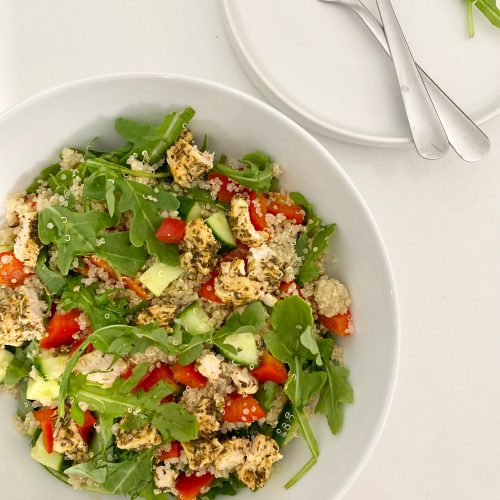
Chicken Quinoa Salad in a white bowl with 2 small white side plates

Chicken Quinoa Salad

The peppery arugula blends wonderfully with the quinoa and chicken for a delicious salad! The salad measurements are flexibile - use more or less, depending on what you have!
Course Dinner, Main Course, Salad
Cuisine Mediterranean

Ingredients
  

Salad

  • 2 cups cooked quinoa (about 1 cup uncooked quinoa, and cook according to package directions)
  • 2 cups arugula
  • 1-2 cups cooked chicken (or search for my recipe for Mediterranean Chicken Kebabs)
  • 1/2 cup red onion, finely sliced
  • 1 cup cucumber, diced
  • 1 cup red pepper, diced

Dressing

  • 2 Tbsp olive oil
  • 2 Tbsp cider vinegar
  • 1 garlic clove, minced
  • 1 Tbsp lemon juice
  • 1/2 tsp dried oregano
  • 1/4 tsp pepper

Instructions
 

  • Add cooked quinoa and salad ingredients into a large bowl.
  • In a small bowl, whisk together salad dressing ingredients.
  • Drizzle dressing over salad and toss gently to coat.
Keyword arugula, avocado salad, Chicken kebabs, Mediterranean Chicken Kebabs, quinoa

What are your thoughts on the Dirty Dozen?

A woman shopping for veggies at a grocery store. A headshot of Sue is overlayed with the text "Ask a Dietitian. What are your thoughts on the Dirty Dozen?"


Disclosure: This is a sponsored post with CropLife Canada. The information shared in the blog are my opinions based on my review of this topic. I consult only with companies which align with my personal and professional values.

Have you heard about the Dirty Dozen? Let’s take a closer look at this and what it means for you and your family.

What exactly is the Dirty Dozen?

The Dirty Dozen is an annual list created by the Environmental Working Group (EWG), a United States-based environmental advocacy organization. The list ranks the top 12 conventionally grown fruits and vegetables in the United States that they claim should be avoided due to pesticide residues.

But what the Dirty Dozen list doesn’t tell us is how much residual pesticide is actually on the produce. We need this information to figure out if the amount we’re eating is at a level that could harm our health.

So what about pesticides?

Pesticides are substances that can be from either synthetic or natural sources, and are used on foods to protect them from diseases and pests such as insects and weeds. With the help of pesticides, farmers are able to grow safe, affordable and abundant food for Canadians.

As a dietitian, I worry that the Dirty Dozen list may cause food fear. The fact is both organic and conventional farmers use pesticides to control pests. Just because a pesticide residue is present, doesn’t mean that it poses a risk to our health. In fact, detection technology is now so sophisticated that it can detect parts per billion (think a drop of water in an Olympic size swimming pool). And, Canada has one of the most stringent regulatory systems in the world for pesticides. Before a pesticide can even be used on a food product, Health Canada assesses the health impact of any pesticide residues that may be in or on the food. It even takes into account the sensitivities of specific subsets of the population like infants, children and pregnant women.

Health Canada also sets Maximum Residue Limits (MRLs), which is the maximum amount of pesticide residue that is allowed to remain on a product when it is used according to the pesticide label – and these residue limits are typically set at least 100 times or more below levels that would have any impact on human health.

The Canadian Food Inspection Agency inspects domestic and imported foods for pesticide residues. Over 99% of the food that is tested is below the MRLs. And in rare cases where the residue level is above the MRL, it does not pose a health risk as the MRL is set significantly below any level of concern.

My advice

We all want and deserve safe, nutritious and affordable food for ourselves and our families. Here are some things to consider if you’re concerned about pesticides.

  • Put the Dirty Dozen list in perspective. Health Canada states that there is no health risk from eating conventionally grown foods because of pesticide residues. Use this Pesticide Residue Calculator which shows you the number of servings of different fruits and vegetables that we could eat and still not have any adverse effects from pesticide residues. For example, a child could eat 181 servings of strawberries a day (or 1,448 strawberries) without any adverse effects from pesticide residues!
  • Wash fruits and veggies very well under cold water. This helps to remove dirt, bacteria, and any tiny amounts of residues which may be on the outer layers of the produce. There’s no need to use soap or detergent. You can also peel the skin on fruits and veggies, however keep in mind that you’d also be peeling away some fibre and nutrients, as well as contributing to food waste.
  • Feel good about the food you eat! Enjoy a variety of fruits and vegetables every day that are tasty and affordable. Whether they’re organic or conventionally grown, both options are safe, nutritious and important for good health.


Summertime Eating Tips – from a Dietitian who LOVES dessert!

Collage of fresh summer produce including peaches, lettuce, cherries and red peppers


Helloooo Summer!

Who’s ready to fire up the BBQ and enjoy all the glorious seasonal produce? As an award-winning dietitian and daughter of a chef, I’m first in line for delicious, wholesome food – and yes, that includes dessert!

Here are my 4 tips for guilt-free summertime eating, with inspiring recipe ideas from my friends Nik and Carol over at Weekend at the Cottage!

1. Colour it up!

Think of fruits and veggies as Mother Nature’s superheroes – not only are they rich in vitamins and minerals, but they’re also filled with different disease-fighting plant-nutrients also called ‘phyto-nutrients’.

Tomatoes and watermelon for example, are packed with lycopene – it’s what gives these foods a red pigment. Lycopene may help lower your risk for heart disease and prostate cancer. Orange coloured produce such as carrots, cantaloupe, peaches and apricots contain carotenoids like beta-carotene to support your vision and reduces your risk for heart disease and some types of cancer.

Love blueberries? Me too! They contain a special plant nutrient called anthocyanins that are linked to healthy aging and brain health. And what about spinach, kale and Swiss chard? Well, all those leafy greens are packed with lutein, a special antioxidant that lowers your chances of developing age-related macular degeneration.

Dietitian Sue’s tip: At every meal, fill half your plate or bowl with colourful fruits and veggies. Salads are an easy way to get in those colours. Try this Tomato Avocado Salad or Chopped Kale Salad.

 2. Pick your protein

What’s calling your name? Burgers, ribs, poultry, tofu, shrimp?

Pick a protein at every meal. Protein helps you feel alert and full for longer. As part of a meal, protein also slows down the digestion of carbohydrates. This gives you a slow, steady rise in blood sugar levels which is beneficial for anyone with prediabetes or diabetes.

Dietitian Sue’s Tip: Choose lean proteins more often. One of my family faves are Mediterranean Chicken Kebabs and you could swap out the chicken for pork or cubes of firm tofu. For a smart protein choice that’s packed with heart-healthy omega-3 fats, aim for two fish meals a week – like Nik’s Grilled Salmon Burgers and Barbecued Salmon.

3. Find the fibre

We need 25-38 grams of fibre a day. But guess what? Most of us are only getting half that amount. Soluble fibre, found in strawberries, oatmeal and apples play a role in keeping our blood cholesterol levels healthy. Insoluble fibre, found in beans, bran and broccoli, help to keep us regular.

Dietitian Sue’s Tip: If you’re filling half your plate or bowl with fruit and veggies, then you’re already off to a great start! Try Granola or a high fibre breakfast cereal that contains at least 4 grams of fibre per serving. Check out my TV interview ‘Simple Ways to Boost Your Fibre’ for easy ways to pump up the fibre in a day’s worth of meals.

4. Make room for dessert

 I love dessert…as in, I eat dessert every night! For me, it’s really the best part of the meal! Sometimes, dessert is a bowl of fresh fruit salad or a few slices of ice cold watermelon. And sometimes, it’s Peach Cobbler or French vanilla ice cream on a waffle cone or a slice of gluten-free Chickpea Chocolate Cake. Whatever you choose for dessert, dig in and enjoy!

Dietitian Sue’s Tip: Let go of the ‘good food’ versus ‘bad food’ thinking. Give yourself permission to enjoy all foods in moderation without any guilt. Food is joy, and eating together with family / friends is always a celebration!

What recipes are you most excited to try? Let me know in the comments. Happy summer, everyone!


What to Eat Before & After the COVID-19 Vaccine

Medical professional wearing blue gloves and about to give a needle to a patient in the armAre you ready to get your jab? You don’t need a special diet before getting your COVID-19 vaccine. But there are a few extra food considerations at this time. Here’s what you can do to get ready and manage potential side effects.

BEFORE getting the COVID vaccine:

  • Take your regular medications as usual. Get a good night’s sleep.
  • Have a snack or light meal depending on the time of your vaccine. The goal is to avoid going for your vaccine on an empty stomach, especially if you have a fear of needles or a history of feeling lightheaded / faint with needles.
  • Eat familiar foods. As a former sports dietitian, I always advised athletes to avoid eating any new foods on “game day.” Consider vaccine day as your “game day” and stick to foods you know so that you don’t trigger any stomach upset.
  • Make some meals made in advance in case you’re too tired or unwell to cook dinner for the next few days after getting the vaccine.

AFTER getting the COVID vaccine:

  • Stay hydrated. You might have a mild fever after getting the vaccine. Keep your mug or water bottle nearby to remind you to get enough fluids throughout the day.
  • Take in some comfort food. Some common symptoms after the vaccine are like chills, fatigue and muscle aches. Try a bowl of chicken noodle soup or your favourite soup to offer some comfort. And cuddle up with a cozy blanket.
  • Hold off on the alcohol. It can dehydrate you even more. Chances are you may not be in the mood for a drink anyway, and less so if you’re feeling headache, chills or the aches.
  • Continue eating a wholesome diet to keep your immune system strong. Think of your immune system as a team with different players. Each player has a role to play. Nutrients like vitamin A, vitamin C, vitamin D, vitamin E, protein and zinc are just some of the key players on Team Immune System. Fill half your plate or bowl with a variety of colourful veggies and fruit. Get vitamin D from eggs, fatty fish, milk, mushrooms, fortified beverages and supplements if needed. Look for whole grains, lean meats / fish / poultry and plant-based foods like tofu, nuts and seeds.

 Keep well everyone!


5 Things You Can Do Today to Reduce Food Waste

A canvas grocery bag filled with bananas, oil and cucumbersFood waste is a growing concern now more than ever!

Research from the National Zero Waste Council found that 63% of the food that we throw away – mostly veggies and fruit – is avoidable and could have been eaten. The edible food that we toss into our compost or green bins adds up to $1,100 per year for the average household! Across Canada, all of this household food waste amounts to about 2.2 million tonnes of edible food that’s thrown out each year. To put that into perspective, picture this – EVERY DAY in Canada, we waste*:

  • 4 million potatoes
  • 2 million tomatoes
  • 2 million apples
  • 555 thousand bananas
  • 470 thousand heads of lettuce
  • 1 million cups of milk
  • 750 thousand loaves of bread AND
  • 450 thousand eggs

(*Reference: https://lovefoodhatewaste.ca/about/food-waste/)

WHOA!! OK, let’s just take a moment to “digest” that info!

Aside from the financial costs of food waste, food that sits in landfills creates methane, a greenhouse gas contributing to the climate crisis. With Earth Day approaching on April 22, it’s a reminder that we can and must reduce food waste. Here are a few ideas to get started along with links to more tips and cookbooks.

Store your fruits, veggies and herbs to help them last longer

Did you know that wrapping banana stems slows down the ripening? Check out my national TV interview for these and other tips on how to store celery, lettuce, avocado and freeze your leftover herbs.

TV host Ann-Marie Mediwake talking to Sue in a virtual TV interview For more food storage tips, go to https://lovefoodhatewaste.ca/keep-it-fresh/ or https://www.halfyourplate.ca/fruits-and-veggies/store-fruits-veggies/

Plan your meals

Look for recipes that use the same ingredients enjoyed in different ways. Take a bunch of carrots for example – eat them raw with a dip; chop them for a soup or chili; grate them for a salad or muffins; cut them into matchsticks for roasting; or slice them for a stir-fry. What about yogurt? Make a yogurt parfait for breakfast or dessert; mix a big scoop of yogurt into your muffin or loaf batter; and add a swirl of yogurt into your carrot soup!

Use what you have on hand

Be creative. What foods and ingredients do you already have on hand? How can you turn those foods and ingredients into a yummy meal? In a recent study of over 1,000 Canadian families by Hellmann’s and BEworks (a consulting firm studying behaviour economics and insights), food waste was reduced by 33% when participants planned a “Use-up day” each week by making a meal with soon-to-expire ingredients.

Try recipes like Sweet Potato Enchiladas, Veggie Fritters or Tomato Risotto with Grilled Romaine lettuce – all from the Rock what You’ve Got free e-cookbook by the Guelph Family Health Study. Even IKEA has launched their The Scraps Book free downloadable cookbook with recipes using food scraps from featured chefs across North America.

Practice first in, first out (FIFO)

Anyone else have hidden cans of tuna at the back of their cupboard? When putting the groceries away in your fridge, freezer or pantry, use the FIFO rule. Rotate the canned goods, eggs, yogurt, juice and other items so that the ones with the closest best-before dates are moved to the front to be eaten first. I also label my leftovers with the date written on a piece of masking tape so I know which ones to eat first.

Know the difference between the “best-before date” and the “expiry date”

Only packaged foods with a shelf-life of 90 days or less must have a best-before date. Foods that will last longer than 90 days (such as canned food, rice, pasta, dried beans, nuts and frozen food) don’t need a best-before date, but many food companies choose to put one on anyway.

Best-before dates are based on the food’s freshness and quality, rather than the safety of the food. According to the Canadian Food Inspection Agency, you can buy and eat an unopened food AFTER the best-before date has passed. However, keep in mind that after the best-before date, the food may lose some of its freshness, flavour and nutritional value, and /or its texture may change.

The expiry date is not the same as the best-before date. Only certain foods like meal replacements / drinks and infant formulas must have an expiry date. After the expiry date, the nutritional value of these foods will be different than what is listed on the label. Don’t eat these foods if they are past their expiry date.

What’s your “fridge clean-out” recipe? Take a photo and tag me on Instagram or Twitter @SueMahRD – I want to see your recipes!

Want more? Read my other blogs: 

Put the Freeze on Food Waste

10 Ways to Eat Better for the Planet

Find Your Healthy with Traditional Cuisines – Week 5

Birds eye view of a platter of chicken paprikas served with Hungarian nokedli dumplings

*To celebrate National Nutrition Month, we have a 5-week series of guest posts written by Deepanshi Salwan, MPH candidate and a dietetic graduate student at the University of Toronto.**

Welcome back to week 5 of the Nutrition Month 2021 blog series! It is the last post of the series. Thank you all for following along!

This year Nutrition Month centres on the idea that healthy eating looks different for everyone. It is not a one-size-fits-all approach, and your healthy eating will look different from someone else’s healthy eating based on culture, food traditions, personal circumstances, and nutritional needs.

To honour  Nutrition Month, I have teamed up with Registered Dietitians and Dietetic Graduate Students from diverse cultural backgrounds to put together a Nutrition Month 2021 blog series! Each week for the month of March, different dietitians and dietetic students will share their food traditions, cultural recipes, and the importance of culture in healthy eating.

Embrace your heritage through cultural foods!

In Week 1, we talked about how cultural foods should be a part of your healthy meals. Read the post here.

In Week 2, we talked about the importance of forming social connections through cultural food. You can find the post here. 

In week 3, we talked about the importance of instilling cultural food heritage in your children. You can find the post here

In week 4, we talked about building a community that appreciates everyone’s food cultures. Read the post here.

Today we will succinctly summarize the valuable lessons from previous weeks and provide an action plan to help you embrace your cultural foods. To wrap up this series, we have my colleagues Lucia Weiler and Lalitha Taylor with us.


Headshot of Lucia Weiler

Lucia Weiler, RD, PHEc

Lucia Weiler, RD, PHEc

www.weilernutrition.com  

Instagram: @LuciaWeilerRD

Twitter: @LuciaWeilerRD

  1. What’s your cultural background?

I am Hungarian.

  1. What is the meaning of food in your culture? / How is food used in celebrations or traditions?

Food is family – and food is love. Hungarians know how to cook everything – snout to tail, farm to table. Many like my grandmother and sister are excellent bakers too though that’s not my forte.

  1. What is your favourite cultural ingredient or food or recipe?

Hungarian Cuisine in short! Paprika is the heart of Hungarian cuisine and the traditions go all the way back to the first Hungarians, and some of the dishes have been cooked the same way for hundreds of years. Here is the resource that lists our traditional dishes.

Chicken Paprikas with Hungarian Nokedli dumplings on a platter

Hungarian Chicken Paprikás with Nokedli (Image: Canva)

Chicken Paprikás is a classic simple and good recipe. I make it regularly! Here is the recipe.

Ingredients:

2 ½ -3 lb chicken thighs or drumsticks, 2 onions, chopped, 2 garlic cloves, minced, 2 tbsp vegetable oil, 2 tbsp Hungarian ground paprika, ½ tsp ground black pepper, 2 bell peppers, chopped, 2 tomatoes, chopped, 2 cups water or low sodium chicken broth, ½ cup sour cream, 1 tbsp flour

Instructions: In a large skillet, heat oil and brown chicken on all sides – remove chicken to a plate. Next, add onion to the skillet and cook till golden brown. Add garlic, pepper and tomatoes and cook for another 3 minutes. Turn off heat and stir in the paprika and ground black pepper. Return chicken to the skillet and mix well. Add water or chicken broth until chicken is mostly covered. Bring to boil, cover, reduce heat and simmer for 30 minutes. In a small bowl, mix sour cream and flour until the mixture is smooth. Add the sour cream mixture to the chicken paprikas and simmer for 5 minutes until sauce is thickened. Serve with Hungarian nokedli (small dumplings) or penne or rotini. [For a vegetarian version, replace chicken with tofu cubes and reduce cooking time to 10 minutes].

Dietitian’s tip: Serve some veggies on the side such as steamed broccoli or green beans. A fresh cucumber or tomato salad is also fitting. Enjoy! Jó étvágyat!

4. What would you like to say to Canadians during National Nutrition Month?

Enjoy and explore how your culture, food traditions, personal circumstances & nutritional needs all contribute to what healthy looks like for you. Reach out to a registered dietitian to support your healthy eating journey.


Headshot of Lalitha Taylor

Lalitha Taylor, RD

Lalitha Taylor, RD

www.taylornutrition.ca

Instagram:  @lalithataylor_rd

Twitter: @lalithataylor

1. What’s your cultural background?

I am half South Indian and the other half is a mixture of Guyanese, Dutch and Bajan.

  1. What is the meaning of food in your culture? / How is food used in celebrations or traditions?

Food in many ways means love to me in my culture. After I left my parent’s home and moved away, every time I returned to see them the first thing my Dad would say is, “Are you hungry? What do you want to eat?” Food has always been a means for my parents to show their care, warmth and love.

To this day, mom will spend days meticulously preparing Indian dishes for special events to ensure we always have enough plus some to share with others. Given my diverse background—celebrations usually include a food combination of Indian, Guyanese, Ukrainian and more. Food is the centre of stories, laughter, crying and celebration. In our culture, food is what draws us together and is always offered to family and friends no matter what time of day.

Birds eye view of a platter of Indian Dahl served over basmati rice

Indian Dahl served with Basmati Rice (Image: Canva)

3. What is your favourite cultural ingredient or food or recipe?

Dahl is an Indian stew and my favourite recipe. It’s comfort food and reminds me of my parents. I now make dahl for my daughter and one day, I suspect she will make dahl for her family. It warms my heart to know that these foods will be passed down from generation to generation along with the positive nostalgic memories. You can find a Dahl recipe here.

4. What would you like to say to Canadians during National Nutrition Month?

There is no “cookie-cutter” approach to our eating—especially when we put into context the uniqueness of everyone’s background which includes honouring people’s culture, food preferences and traditions.

Bottom Line

Your cultural foods and traditions are an expression of your identity! They give you comfort, remind you of favourite memories, and help you bond with loved ones. They also give your child a sense of belonging. Cultural foods are fulfilling and they nourish your body and soul. They make you happy! This is why cultural foods and traditions are so important for your health and wellbeing.

Takeaways

1. Make cultural foods a part of your healthy eating

  • Registered Dietitians can provide you with personalized nutrition advice. They can work with you to incorporate cultural foods in ways that are balanced and satisfying. Click here to find a dietitian near you.

 2. Connect with your loved ones through your cultural foods and traditions

  • Grow, harvest, fish, hunt, and prepare foods in traditional ways with loved ones
  • Celebrate occasions and special holidays with cultural foods and practices
  • Eat the same cultural dish together with your family, in-person or virtually

3. Foster your children’s connection to your cultural heritage through food

  • Cook together a new dish from your culture
  • Ask them to notice aromas and flavours during cooking and eating
  • Talk to them about cultural ingredients, how they are produced and used in recipes
  • Add a cultural ingredient to foods they currently enjoy eating
  • Explore grocery stores, bakeries and restaurants that offer your cultural foods
  • Share your stories and memories with foods from your culture

4. Build a community that appreciates everyone’s food cultures

  • Host a potluck where everyone brings a traditional dish and spend time sharing the meaning of these foods (of course, post COVID!)
  • Try a recipe from a different culture – find them online or ask someone you know
  • Explore the International Aisle in grocery stores
  • Dine-in or order take out from different ethnic restaurants
  • Be curious and ask questions or read about other cultures’ food traditions
  • Attend cultural food festivals like Pan Asian Food Festival and Taste of Danforth

 5. Embrace and flaunt your cultural food traditions

    • Connect with community members or Elders to learn more about your food traditions
    • Talk to others about the significance of your cultural dishes
    • Post photos of your cultural foods on social media. It is a great conversation starter

I thank Lucia and Lalitha for their time and contribution to this post.

headshot of Deepanshi Salwan

Deepanshi Salwan

Written by: Deepanshi Salwan, MPH candidate – Deepanshi is a dietetic graduate student at the University of Toronto. Her nutrition philosophy embraces moderation without deprivation. She believes that healthy eating does not have to be complicated and hopes to inspire her audience to live more happy and healthy lives! You can find her on Instagram @deeconstructing_nutrition.


Find Your Healthy with Traditional Cuisines – Week 4

Middle Easter Dolma - grape leaves stuffed with rice and meat - arranged in a white bowl with sliced lemons in the background*To celebrate National Nutrition Month, we have a 5-week series of guest posts written by Deepanshi Salwan, MPH candidate and a dietetic graduate student at the University of Toronto.**

Welcome back to the Nutrition Month 2021 blog series!

This year Nutrition Month centres on the idea that healthy eating looks different for everyone. It is not a one-size-fits-all approach, and your healthy eating will look different from someone else’s healthy eating based on culture, food traditions, personal circumstances, and nutritional needs.

To honour  Nutrition Month, I have teamed up with Registered Dietitians and Dietetic Graduate Students from diverse cultural backgrounds to put together a Nutrition Month 2021 blog series! Each week for the month of March, different dietitians and dietetic students will share their food traditions, cultural recipes, and the importance of culture in healthy eating.

Build a community that appreciates everyone’s food cultures

In Week 1, we talked about how cultural foods should be a part of your healthy meals. Read the post here. In Week 2, we talked about the importance of forming social connections through cultural food. You can find the post here.  In week 3, we talked about the importance of instilling cultural food heritage in your children. You can find the post here.

Today we transition a bit from focusing on our culture to exploring food options from other cultures. I believe we grow a little more when we step out of our comfort zone and appreciate something from a different culture. Similarly, rejecting foods from a different culture before tasting them would be a missed opportunity to grow. In Canada, we do not just tolerate other cultures, we celebrate them, and it should be no different when it comes to food. 

How do you build a community that appreciates everyone’s food cultures? Let’s hear from my colleagues Atour Odisho and Aleeya Zack-Coneybeare!

head shot of Atour Odisho

Atour Odisho, Dietetic Graduate Studen

Atour Odisho, Dietetic Graduate Student

Instagram: @atour.in.nutrition

  1. What’s your cultural background?

I am Middle Eastern

  1. What is the meaning of food in your culture? / How is food used in celebrations or traditions?

In my culture, food is medicine, and in my upbringing food is emphasized in the role of nutrition and healing. It is also a way to celebrate with family and friends. There is never too much food!

  1. What is your favourite cultural ingredient or food or recipe?

My favourite cultural food is dolma, which is wrapped grape leaves. I love this because every Middle Eastern has a different twist to it.  Here is my recipe.

Dolma arranged on a white plate with cut lemons in the backgound

Dolma [Image: Canva]

Ingredients: 4 cups white basmati rice, 8 tomatoes, chopped, 2 bunches of flat parsley, chopped, 4 cloves of garlic, 1 can of tomato paste (or salsa), 1/3 cup pomegranate molasses (or to taste), about 3/4 cup lemon juice, 1 tbsp of extra virgin olive oil, 1 tbsp dill (or to taste), 1 tbsp of sumac, salt & pepper to taste, and 18 oz of grape leaves. You can also mix in 1 pound ground beef or lamb.

Instructions: Mix everything together, except the grape leaves. Once everything is mixed, stuff each grape leaf with the mixture. Make sure all sides are closed, so the rice doesn’t escape when cooking. Next, assort the wrapped grapes leaves in a big pot. Add water and some more lemon juice to cover all grape leaves. Add in an appetizer plate and press down to secure the grape leaves together. Set on high-medium heat until water boils, then let it simmer for 30 minutes. ENJOY!

4. What would you like to say to Canadians during National Nutrition Month?

I hope that Canadians continue to explore other cuisines and dishes to diversify their palates. Cook traditional dishes from other cultures, dine-in restaurants from various cultures, explore International food aisles, or just be curious and ask questions!

head shot: a grad photo of leeya Zack-Coneybeare

Aleeya Zack-Coneybeare
Dietetic Graduate Student

Aleeya Zack-Coneybeare, Dietetic Graduate Student


  1. What’s your cultural background?

I am Ojibway which is an Indigenous group here in Canada.

  1. What is the meaning of food in your culture? / How is food used in celebrations or traditions?

Food is ingrained within every aspect of our culture; it represents our way of life. Food connects our people to our traditions, our spirit, and our ancestors. Food plays an important role in our traditional ceremonies, as most usually end in a feast. We also use food to honour our spirits, ancestors, and mother earth by offering a spirit plate before beginning a feast. A spirit plate is filled with samples of all the food items at the feast, we set it outside and offer a prayer.

  1. What is your favourite cultural ingredient or food or recipe?

My favourite cultural ingredient is wild rice, due to its rich nutrients and the variety of recipes and meals it could be added to.

My family makes Turkey and Wild Rice soup very often! Here is the recipe.

Turkey and Wild Rice Soup in a white bowl with a spoon, taken at a birds eye view

Turkey & Wild Rice Soup [Image: Canva]

Ingredients:

Turkey Stock -Turkey carcass (from a roasted bird), 1 carton chicken broth, 1 carton chicken broth, 1 onion, 2 celery sticks, 2 carrots, basil leaf, 1tsp thyme, water to cover

Soup – chicken or vegetable stock, ¾ wild rice, 2 carrots, bite-size, 2 celery sticks, bite-size, 1 tsp chicken bouillon, half yam, chopped, ½ cup corn, 2 cups shredded/chopped turkey meat

Instructions: 

Turkey Stock – In a large pot add carcass, chicken broth, onion, celery and carrots. Add enough water. Add salt, pepper, thyme and basil leaf. Bring to boil and simmer on low for 12 hours. Strain and put the stock back into the pot.

Soup – Add a carton of chicken/vegetable broth to the stock (Taste and add chicken bouillon if needed). Bring to a boil and add wild rice (cook for 30 minutes on a low boil). Add freshly chopped celery and carrots (cook for 10-15 minutes). Add chopped yam (cook for 10-15 minutes). Add corn (cook for 5-10 minutes). Add shredded/chopped turkey meat (cook for 10 minutes). Turn off heat and ready to serve!

4. What would you like to say to Canadians during National Nutrition Month?

I would like to say to Canadians, the Indigenous cuisine is beautiful and that I highly recommend exploring our foods and culture and all the other diverse cuisines Canada has to offer!

Bottom Line

Being accepting and wholeheartedly celebrating other traditional cuisines will allow Canadians of colour to enjoy their cultural foods with pride. There will be no guilt around carrying their cultural foods with them to school, work, or anywhere else they go. As we have discussed through this series, enjoying cultural foods is an important aspect of healthy eating. So, help your fellow Canadians to find their healthy by appreciating their cultural foods and practices!

Come back next week to learn more about traditional cuisines and healthy eating in our final post of the Nutrition Month 2021 blog series. Click here to learn more about the Nutrition Month 2021 campaign.

Let’s Talk

Have you ever tried a dish from a different culture and instantly fell in love with it? Let us know in the comments below!

headshot of Deepanshi Salwan

Deepanshi Salwan

Written by: Deepanshi Salwan, MPH candidate – Deepanshi is a dietetic graduate student at the University of Toronto. Her nutrition philosophy embraces moderation without deprivation. She believes that healthy eating does not have to be complicated and hopes to inspire her audience to live more happy and healthy lives! You can find her on Instagram @deeconstructing_nutrition.